INTERVIEW WITH DAVE ELLEFSON: Cryptic Writings
Dave Ellefson explains the concept and changes behind the album 'Cryptic Writings', including abandoning the mascot Vic Rattlehead on the cover, the thematic evolution of the lyrics, the experimentation with instruments in the Nashville studio, and the benefits of an extensive pre-production process. He also addresses the change of producer and his own parallel projects (a book).
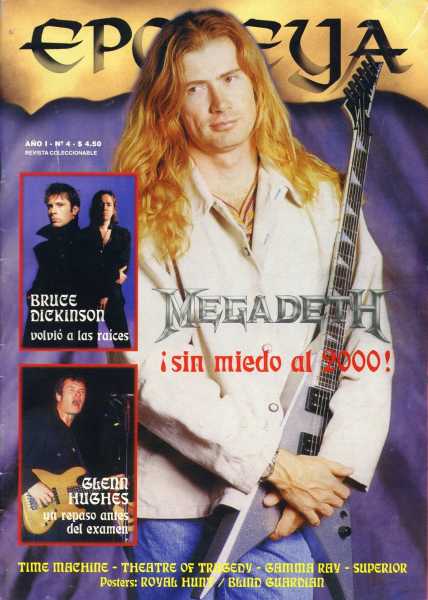
Date
July 1, 1997
Media
Epopeya (AR)
Interviewer
Daniel Oliveira
Interviewees
Daniel Oliveira
Is there a special concept behind 'Cryptic Writings'?
Dave Ellefson
“The album just brings a collection of themes, and strangely enough, 'Cryptic Writings' unites them into an overall vision. This title means something imaginary. Having come up at the last minute, it is quite appropriate. It was taken from the lyrics of 'Use the Man'. There is nothing beyond that, it's quite simple.”
Daniel Oliveira
Originally, the album was going to be called 'Needles & Pins', why did you change to 'Cryptic Writings'?
Dave Ellefson
“We didn't like the art for 'Needles & Pins'. The idea of 'Cryptic Writings' seemed stronger. So we quickly made new art that we liked a lot. The cover features some symbols, open to the imagination and interpretation of the listeners.”
Daniel Oliveira
'Cryptic Writings' is the third consecutive album whose cover does not feature the mascot Vic Rattlehead, why haven't you used him anymore?
Dave Ellefson
“Vic is still used in t-shirt art and similar things, but he can be in the background now, without being a Megadeth banner. With the crossbones skull, Vic was a synonymous image associated with 80s heavy metal. We are almost in the year 2000, so we want to move on without always depending on the past.”
Daniel Oliveira
The last three Megadeth albums had defined concepts about nuclear war ('Rust in Peace'), human extinction ('Countdown to Extinction') and youth without perspective ('Youthanasia'), why is the concept of 'Cryptic Writings' more expressionistic?
Dave Ellefson
“Many lyrics emerged as the album was being composed. We have been associated with social consciousness and political perception, which were worrying topics. For example, as we get older we can't always sing about the same things, we would be stagnant. As a musician and artist, you need to evolve and stop being like you were at 18 years old. Our fans respect that and trust that a Megadeth album will not recycle old themes. There will always be new things.”
Daniel Oliveira
Two tracks on 'Cryptic Writings' have very strange names; 'She Wolf' and 'Use the Man', what do they mean?
Dave Ellefson
“'She Wolf' is about a vengeful woman who is looking for money. She is a selfish type, wanting to be number one at any cost and stepping on others. 'Use the Man' refers to drugs, as the lyrics say: 'I saw the man use the needle, and the needle use the man'.”
Daniel Oliveira
Some songs on 'Youthanasia' already talked about the fight against drugs, why repeat the same thing in 'Use the Man'?
Dave Ellefson
“Dave Mustaine and I met the director of a drug rehabilitation clinic. A boy was there but was caught again and died of an overdose. The song is inspired by this person and not people in general.”
Daniel Oliveira
Unlike previous albums, 'Cryptic Writings' has some instruments other than guitar, bass, vocals, and drums. The sitar on 'A Secret Place', the sound effects on 'Almost Honest' and the atmospheric keyboards on 'Trust' are just a few, how did this come about?
Dave Ellefson
“The good thing about 'Cryptic Writings' is that it was recorded in Nashville (the capital of Tennessee, US East Coast), where there were several studio musicians at our disposal. If we wanted to use other instruments, we wouldn't need to simulate them on the keyboard. We could hire real musicians, achieving an authentic sound. Marty (Friedman) played the sitar, and the producer and engineer also placed some sound effects. Making an album is completely different from playing live. In the studio you can rewind the tape and try different ideas. So it's fun to experiment.”
Daniel Oliveira
Just like 'Elysian Fields' on 'Youthanasia', the track 'Have Cool, Will Travel' features bagpipe solos. Will this bagpiper always play with Megadeth?
Dave Ellefson
“The musician who played on 'Youthanasia' is different. The new one is a Nashville musician, suggested by the producer. The bagpipes were introduced in those two songs but will not be a new instrument in Megadeth.”
Daniel Oliveira
The intro to 'Use the Man' is an old pop song, where did it come from?
Dave Ellefson
“It's called 'Needles & Pins', but I forgot who composed it. It's a 60s song that fits with the needles and pins subject of the song 'Use the Man'. It's about this concept of drug abuse.”
Daniel Oliveira
The guitars at the end of 'She Wolf' are quite reminiscent of Iron Maiden, are you also influenced by old heavy metal?
Dave Ellefson
“Yes, you can hear our influences ranging from The Beatles to Montrose and Ted Nugent, and ending with Iron Maiden and Motorhead. Various bands have influenced Megadeth over the years.”
Daniel Oliveira
Dave announced that 'Cryptic Writings' would have four heavy tracks, four more accessible ones, and four mixing the two styles. Was that really intentional?
Dave Ellefson
“Yes, we planned songs with different styles. The band continues to evolve. It is important to compose songs for our heavy metal fans, we are not going to change things for them. But we don't depend only on this audience, because heavy metal has changed. Many people who listened to Megadeth now have families and jobs, so they don't buy albums or listen to much heavy metal. Music changes over time. To stay up to date, an artist must see what is around them, they don't need to imitate, but they must be aware of things.”
Daniel Oliveira
Last year Dave said he would work more on the production of 'Cryptic Writings', were there big advantages to this?
Dave Ellefson
“Yes, because 'Youthanasia' was composed and recorded all at once. With 'Cryptic Writings', Marty and I went to Dave's house and recorded things on an eight-track portastudio. Then we went to a studio and composed more songs, recording them on the portastudio. We continued composing and went to Nashville. Two days before entering the studio, we worked even more on pre-production and composition with Dann. So we went through various phases over nine months. We didn't rush and were able to reflect on the songs before recording them.”
Daniel Oliveira
Why didn't you use Max Norman for production?
Dave Ellefson
“Max already did a lot for Megadeth. To stay up-to-date and contemporary we needed someone different. We wanted to challenge ourselves as artists, coming up with new ideas. A producer is also an artist. Max did a great job with us, but we wanted a new influence.”
Daniel Oliveira
Did he feel cheated by this decision?
Dave Ellefson
“I don't know, it's hard to say. But I know he was quite happy when he heard the album.”
Daniel Oliveira
What was the criterion for choosing Dann Huff?
Dave Ellefson
“Dave always liked his guitar style in Giant. We knew Dann's work in that band. Strangely enough, our manager worked with him during the Giant era. Therefore, it was easy to contact him. Dann is a studio guitarist in Nashville, but he wanted to get involved in production. So he was encouraged to work with us and vice versa.”
Daniel Oliveira
Why record in Nashville?
Dave Ellefson
“Dann has lived and worked there for many years, so he knows the local studios inside out. Also, we had never recorded there. In musical terms, the city is well-equipped and efficient.”
Daniel Oliveira
Why didn't you reuse the Hangar 18 studio, built for the 'Youthanasia' recordings?
Dave Ellefson
“Max bought that studio from us. After 'Youthanasia' was finished, he dismantled it and took it to Los Angeles.”
Daniel Oliveira
'Cryptic Writings' was recorded with each member traveling separately to Nashville to record their instrument, could the fact that the band was not all together in the studio compromise the quality of the album?
Dave Ellefson
“No, because this was not the first recording. We have grown and worked enough to know about these things. Dave was there throughout the recording because he co-produced the album and composed most of the tracks. Logically, Dann was also there. This was very good because Marty, Nick, and I participated more as musicians. We just went into the studio to play. Marty was there longer because 'overdubs' were needed. Nick and I recorded our parts and left. It's not necessary to spend extra time in the studio. Unless there is work, it's a boring place and there is nothing to do. A proverb says that too many cooks can spoil the same recipe. Thus, the focus would be lost if everyone was in the studio giving ideas. It is better to keep the minimum necessary. If you have something to do, do it, if not, leave (laughs).”
Daniel Oliveira
Being a heavy metal musician, did you learn anything special from recording in the country capital?
Dave Ellefson
“After we finished composing the album, in May '96, I began to study music intensely: jazz, theory, reading, and things like that. Thus, my passion for music was revitalized. I felt good and went to Nashville with an open mind. Even though people play country there, most studio musicians don't listen to that style. Since they are very good jazz musicians, I began to respect the Nashville scene.”
Daniel Oliveira
You haven't been involved in parallel musical projects yet, but you wrote a book titled 'Making Music Your Business', what is the content?
Dave Ellefson
“It is scheduled to come out next month. I like to write about things I know and I have a lot of experience in the music industry. At 15, when I wanted to get into music, I remember there was no guide or book written by an experienced musician. Therefore, my book helps young people who want to enter the industry. There are some good books, but they were written by lawyers and businessmen. My book is about the experience of a musician, covering everything: starting a band, promotion, companies, copyrights, tours, etc. The book contains experiences I went through in my career.”
Daniel Oliveira
When and how did you discover that you could be a writer?
Dave Ellefson
“Some years ago, a Los Angeles magazine asked me to write a column, which was quite fun. On the 'Youthanasia' tour, I started writing about tour events on our website. The page is called 'The Obituary' and functions as a diary. The editor of Bass Player magazine saw it and sent me an email asking if I would like to write a column for their magazine. So writing is kind of a parallel project. While Marty, Nick, and Dave do musical projects, I do a non-musical project.”
Daniel Oliveira
But do you have any musical projects planned?
Dave Ellefson
“I was completely exhausted when the 'Youthanasia' tour ended. I didn't play bass for two months, because I needed time to rest. Then I started studying music, which gave me back my enthusiasm. Now I have a different perspective for playing. Sometimes, parallel projects can wear down a band. But this is my opinion, I'm not speaking ill of Marty, Nick or Dave. Now, I am dedicated to Megadeth. If the band stops for some time, maybe I will do a parallel project.”
Daniel Oliveira
Being the members of the original lineup, do Dave and you relate better to each other than to Nick and Marty?
Dave Ellefson
“Dave has a difficult job, because he has to lead a band, and when you are the leader, sometimes it is difficult to behave like any other member. But the truth is that Dave and I are closer than ever. Upon returning from the tour, the four of us went our separate ways. Since we had spent a lot of time together, we needed distance. The good thing about this is that you miss the other person, and the willingness to get together to play again arises.”
Daniel Oliveira
Over the years there have been comparisons between Megadeth and Metallica. Now that the members of Metallica are composing pop songs, could Megadeth expand its territory even further?
Dave Ellefson
“Maybe some people are turning their backs on Metallica and becoming Megadeth fans. Otherwise, I think they can like both bands. I never played with Metallica, so I don't have any grudge against them. Furthermore, they were even useful to us. The fact that Dave played with them was advantageous for us. What Metallica did was good, it paved the way for many bands and helped heavy metal in a general context. I can't speak for them now, I can only say that Megadeth will continue with what it does. On this album, besides expanding our music so that people outside of heavy metal also appreciate it, we made great heavy metal songs.”
Other interviews


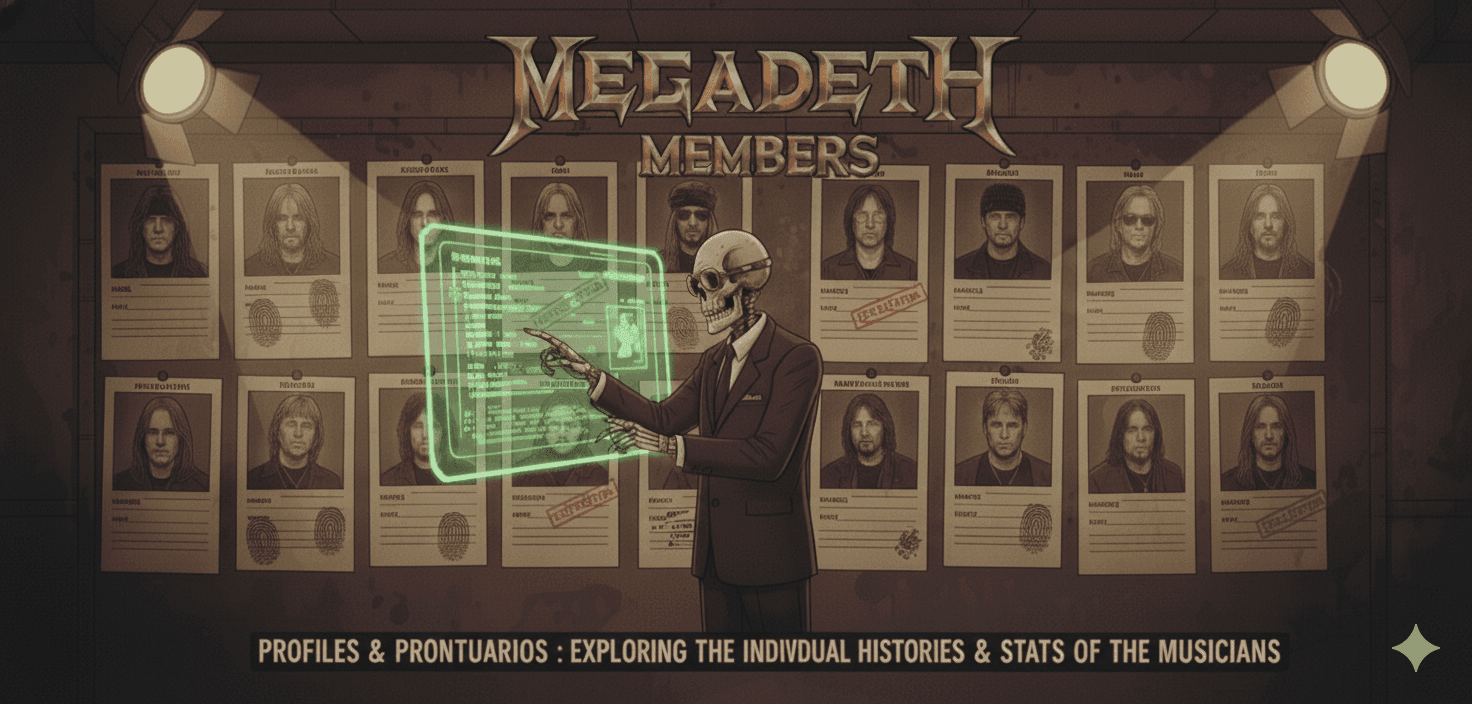
Profile all Megadeth members, meet the musicians behind the legend